This post was inspired by an email exchange with our client, a bathroom and kitchen contractor here in Sacramento. He asked us a simple question: “How can I earn a referral fee on the products my customers are already buying because of me?”
Here’s the situation. When our contractor sells a bathroom remodel, he and the homeowner sit down together, flip through catalogs, browse online stores, and finalize what fixtures, faucets, vanities, and appliances they want. Then the homeowner goes to Home Depot, Amazon, or somewhere else and buys everything.
Our client estimated he’s influencing at least $500,000 per year in household product purchases, and earning zero dollars from those referrals.
That’s a massive missed opportunity.
After reviewing the options, we recommended he look into the Amazon Associates program, Amazon’s affiliate marketing platform. With Amazon handling all the packaging, shipping, fulfillment, and customer support, our contractor can focus on what he does best (remodeling bathrooms) while earning a commission on every product his clients buy through his referral links.
If you’re in a similar position, whether you’re a contractor, interior designer, real estate agent, blogger, or anyone who regularly recommends products, this guide breaks down exactly what you can expect to earn.
What Is the Amazon Associates Program?
Amazon Associates is Amazon’s affiliate marketing program, and it’s one of the oldest on the internet, launched all the way back in 1996. Today, it holds roughly 46% of the affiliate marketing market share, making it the single largest affiliate program in the world.
Here’s how it works: you sign up for a free Amazon Associates account, generate unique referral links for any product on Amazon, and earn a commission every time someone clicks your link and makes a purchase.
A few key details that make the program attractive:
Cart-wide commissions. If someone clicks your affiliate link for a kitchen faucet and then also adds a shower head, bath mat, and a set of towels to their cart, you earn a commission on the entire order, not just the faucet.
24-hour cookie window. After someone clicks your link, you have 24 hours for them to add items to their cart. Once an item is in the cart, Amazon holds your referral credit for 90 days.
No inventory, no shipping, no customer service. Amazon handles everything. You just drive the referral.
Low barrier to entry. There’s no cost to join. You need a website, blog, YouTube channel, or social media presence to apply.
Complete Amazon Affiliate Commission Rates by Category (2026)
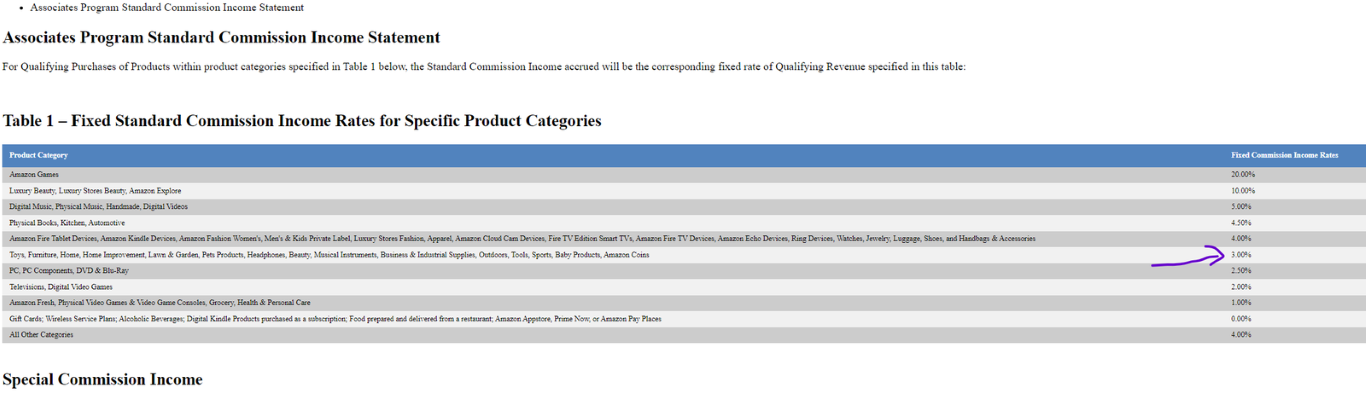
Below is the full breakdown of Amazon’s commission rate structure. These rates are current as of early 2026 and are sourced from Amazon’s official Associates program documentation.
High Commission Categories (10%–20%)
| Product Category | Commission Rate |
|---|---|
| Amazon Games | 20% |
| Luxury Beauty | 10% |
| Luxury Stores Beauty | 10% |
Amazon Games earns the highest rate at 20%, which reflects Amazon’s push to grow its gaming division. Luxury Beauty has consistently held at 10% for several years, making it one of the most profitable categories for affiliates who can drive traffic to premium beauty products.
Mid-Range Commission Categories (4%–5%)
| Product Category | Commission Rate |
|---|---|
| Digital Music | 5% |
| Physical Music | 5% |
| Handmade | 5% |
| Digital Videos | 5% |
| Physical Books | 4.5% |
| Kitchen | 4.5% |
| Automotive | 4.5% |
| All Other Categories | 4% |
This tier is where the bulk of everyday products land. For our contractor client, the Kitchen category at 4.5% is directly relevant, and the “All Other Categories” catch-all at 4% covers a wide range of home-related products.
Lower Commission Categories (1%–3%)
| Product Category | Commission Rate |
|---|---|
| Toys | 3% |
| Furniture | 3% |
| Home | 3% |
| Home Improvement | 3% |
| Lawn & Garden | 3% |
| Pets Products | 3% |
| Headphones | 3% |
| Beauty (non-luxury) | 3% |
| Musical Instruments | 3% |
| Business & Industrial Supplies | 3% |
| Outdoors | 3% |
| Tools | 3% |
| Sports | 3% |
| Baby Products | 3% |
| PC, PC Components, DVD & Blu-Ray | 2.5% |
| Televisions | 2% |
| Digital Video Games | 2% |
| Amazon Fresh | 1% |
| Physical Video Games & Consoles | 1% |
| Grocery | 1% |
| Health & Personal Care | 1% |
Zero Commission Categories (0%)
| Product Category | Commission Rate |
|---|---|
| Gift Cards | 0% |
| Wireless Service Plans | 0% |
| Alcoholic Beverages | 0% |
| Digital Kindle Products | 0% |
| Appstore Purchases | 0% |
Bounty Programs: Fixed-Fee Commissions
Beyond product commissions, Amazon also pays flat bounties when your referrals sign up for Amazon services:
| Program | Bounty |
|---|---|
| Amazon Prime Free Trial | $3 |
| Amazon Prime Video Free Trial | $2.50 |
| Audible Free Trial | $5 |
| Kindle Unlimited | $3 |
| Amazon Music Unlimited | $3 |
| Amazon Baby Registry | $5 |
| Amazon Wedding Registry | $3 |
| Amazon Student Account | $3 |
These bounties can add up quickly, especially if your audience skews toward new homeowners (Baby Registry), couples (Wedding Registry), or anyone who hasn’t yet tried Prime.
How Amazon’s Rates Have Changed Over Time
Understanding the history helps explain where we are today, and why being strategic with your affiliate approach matters more than ever.
2012: The Peak. Amazon’s average affiliate commission rate hit its all-time high of approximately 9.25%. Affiliates were earning generous percentages across nearly all categories, and the program was one of the most lucrative passive income opportunities online.
2017: The Volume-Based Model Ends. Amazon made a major structural change, shifting from a tiered, volume-based commission system (where driving more sales earned you higher percentages) to a flat, category-based rate. This meant that whether you drove 10 sales or 10,000 sales per month, you earned the same percentage. Many high-volume affiliates saw their income drop significantly overnight.
April 2020: The Big Cut. During the COVID-19 pandemic, Amazon slashed commission rates across many of the most popular categories. Furniture, Home Improvement, Lawn & Garden, and similar categories dropped from 8% to 3%. Grocery went from 5% to 1%. The average commission rate fell to roughly 3.14%, about a third of what it was at its peak. These cuts are still in effect today.
2025: New Strategic Categories. Amazon introduced Amazon Games at 20% and Amazon Haul at 7%, signaling which areas of their business they want affiliates to help grow. Amazon also began testing “Native Commerce Advertising,” a program that rewards publishers for driving traffic to Amazon even without a purchase, a significant shift in the affiliate model.
The takeaway? Commission rates have generally trended downward, which means affiliates need to think more strategically about which products to promote and how to maximize the value of each referral.
Real Math: What Could a Service Business Actually Earn?
Let’s go back to our contractor client’s situation and run the numbers.
He influences approximately $500,000 per year in product purchases. If his clients are primarily buying items in the Home, Home Improvement, Furniture, and Tools categories, those fall into the 3% commission tier.
Conservative estimate (3% on $500,000):
$500,000 × 0.03 = $15,000 per year
That’s meaningful passive income for doing something he’s already doing, recommending products to his clients.
But here’s where it gets more interesting. If he creates a curated Amazon storefront or recommendation list that includes higher-commission items mixed in, say, luxury bathroom fixtures (potentially falling under Luxury categories) or kitchen items (4.5%), the blended rate increases.
Optimized estimate (blended 3.5% on $500,000):
$500,000 × 0.035 = $17,500 per year
And if he grows his referral volume by expanding to a blog or YouTube channel with product reviews? The ceiling gets much higher. Top Amazon affiliates with strong traffic earn $5,000 to $50,000+ per month.
Who Should Consider Becoming an Amazon Affiliate?
Most affiliate marketing content is written for bloggers and YouTubers. But there’s a huge, underserved group of professionals who already influence purchasing decisions every day and aren’t monetizing those recommendations:
Contractors and remodelers who recommend fixtures, tools, and appliances during every project.
Interior designers who curate entire rooms of furniture, decor, and accessories for their clients.
Real estate agents who send new homeowner “starter kits” or moving checklists full of product recommendations.
Personal trainers and nutritionists who recommend supplements, equipment, and meal prep supplies.
IT consultants who recommend hardware, peripherals, and software for their business clients.
Teachers and tutors who recommend books, supplies, and educational materials to parents.
If you’re in any of these roles, you’re leaving money on the table every time you recommend a product without an affiliate link attached to it.
Tips to Maximize Your Amazon Affiliate Earnings
1. Think about price points, not just commission rates. A 3% commission on a $800 bathroom vanity ($24) is far more valuable than a 10% commission on a $15 beauty product ($1.50). High-ticket items in lower-commission categories can still be very profitable.
2. Create product recommendation pages. Instead of scattering links across your site, build dedicated recommendation pages, like “Our Top Recommended Bathroom Fixtures” or “Kitchen Remodel Essentials.” These pages compound traffic over time and become evergreen referral engines.
3. Leverage the cart-wide commission. Remember, you earn on everything in the cart, not just the product you linked. If your referral leads to a larger shopping session, your commission multiplies. Linking to high-intent categories (like home improvement) where people tend to buy multiple items at once is a smart strategy.
4. Layer in bounty programs. If you’re already recommending products to new homeowners, a simple “Have you tried Amazon Prime for free shipping on all your project supplies?” can earn you an extra $3 per referral through the Prime bounty.
5. Publish seasonal content. Amazon affiliates report that 30%–40% of their annual income comes during the holiday season (November and December). Planning content around Black Friday, Prime Day, and holiday gift guides can significantly boost your annual earnings.
6. Don’t rely on Amazon alone. Smart affiliates diversify across multiple programs. Home Depot, Wayfair, and other retailers have their own affiliate programs with competitive (sometimes higher) commission rates. We’ll cover this in a future comparison article.
Important Things to Know Before You Start
Payment terms. Amazon pays affiliates 60 days after the end of the month in which commissions were earned. So January commissions arrive at the end of March.
Payment thresholds. You need at least $10 in earnings for direct deposit or Amazon gift card payouts, or $100 for payment by check.
Compliance. Amazon requires clear disclosure that you’re using affiliate links. The FTC also requires this. A simple disclaimer like “As an Amazon Associate, I earn from qualifying purchases” on your site is standard practice.
Account activity. You need to generate at least three qualifying sales within your first 180 days, or Amazon will close your Associates account. Make sure you have traffic before applying.
Rate changes. Amazon can (and does) change commission rates at any time. Building your business around a single affiliate program is risky, diversification matters.
How We Can Help
At HM Marketing, we help businesses turn their existing customer relationships into new revenue streams. Whether you’re a contractor looking to monetize product referrals, a local business exploring affiliate marketing, or a company that needs a complete ecommerce and digital marketing strategy, we can help you build a plan that works.
If you’re looking for ecommerce consulting, affiliate strategy, or marketing help, contact us today for a free consultation.